
Macro & Strategy

Navigating A New Economic Order

Published:
March 2025
Read Time:
8
Mins
Continents on a globe with a line graph indicating the state of the economy

As global markets grapple with seismic shifts in trade, policy, and power, investors face mounting uncertainty. In a hyper-globalized world where trade as a share of GDP is over 45%, this note aims to address two critical questions: What is happening to the post-1945 economic framework as U.S. policies pivot under President Trump, and how should investors think about their portfolios in response to it?

Our Key Takeaways:

  1. Rethink Diversification Playbook:
    Correlation shifts demand bold moves across new trade blocs
  2. Seize Mis-Priced Opportunities:
    Domestic resilience and tech innovation outshine global giants
  3. Unlock Premium Returns:
    Invest in assets resilient to geopolitical chaos, like scarce resources and novel IP
  4. Master the Storm:
    Patience and strategy turn volatility into profit with a long-term vision
  5. Capitalize on Reconfiguration:
    Supply chain resilience and infrastructure lead the new economy

Contextualizing the Shift in Global Dynamics

Since 1945, the U.S. has built a uniquely modern system of global influence, defined not by territorial expansion but by financial and institutional dominance. At its core has been the U.S. dollar, the world’s reserve currency, which places a significant portion of global trade under American legal oversight. Free trade policies, combined with America’s willingness to sustain persistent current account deficits, have fueled global liquidity — albeit at the cost of eroding domestic manufacturing in the U.S. Along with this, the financial architecture has been reinforced through international institutions like the IMF and World Bank, and the SWIFT payment system has regulated the flow of capital.

U.S. Trade Deficit (Net Exports of Goods and Services)
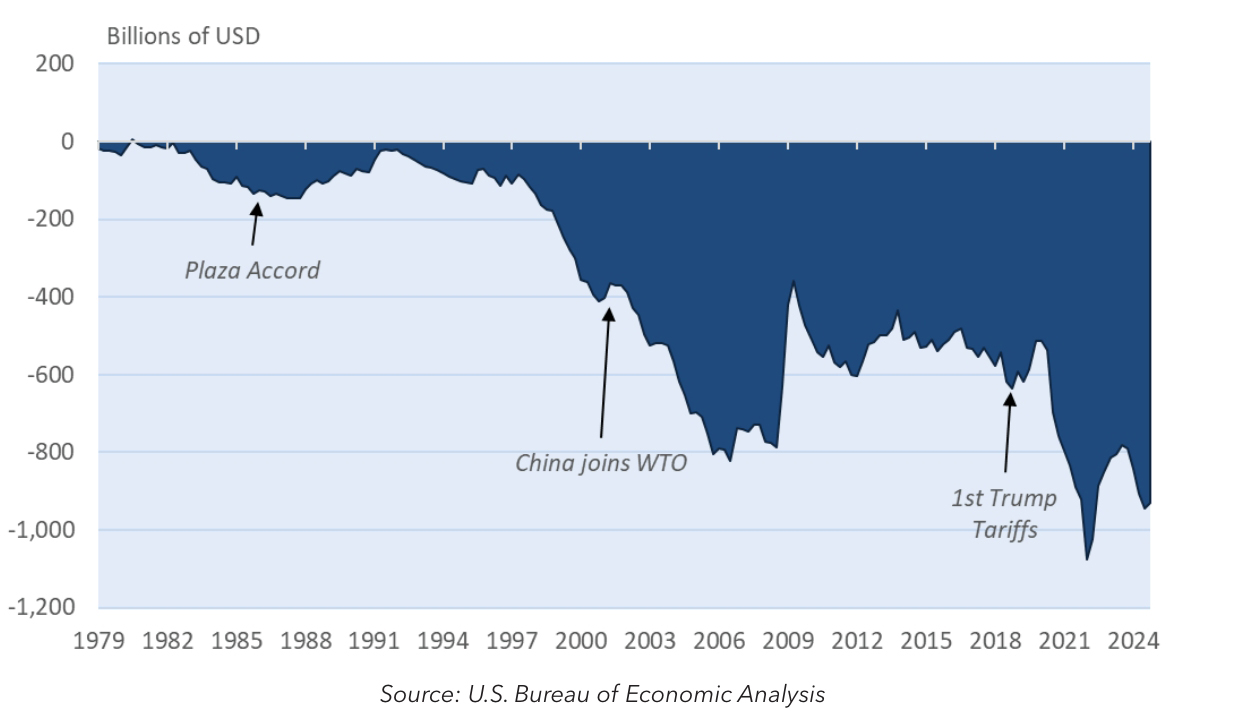
U.S. Trade Deficit

A Return to American Isolationism

This post-war internationalist approach, however, may be a historical anomaly rather than the norm. The roots of American foreign policy stretch back to 1823 with the Monroe Doctrine, which effectively divided the world into spheres of influence. This doctrine, establishing America’s dominance in the Western Hemisphere while avoiding European entanglements, has arguably been America’s default position throughout much of its history. U.S. involvement in both World Wars represented departures from this isolationist tendency. Indeed, without Pearl Harbor and Hitler’s declaration of war against America, U.S. participation in World War II might never have materialized. The subsequent post-war consensus, with America leading global recovery efforts, could therefore be interpreted as a continuation of this exceptional period rather than America’s natural stance.

This doctrine, establishing America’s dominance in the Western Hemisphere while avoiding European entanglements, has arguably been America’s default position throughout much of its history.

The Trump Administration’s Paradigm Shift

President Trump’s policies are now directly challenging the established post-war order, fundamentally reshaping the U.S.’s role in key areas:

  • Unilateralism Over Multilateralism:
    President Trump prioritizes independent action—such as imposing tariffs or threatening to withdraw from international agreements—over cooperation through alliances or institutions like the IMF, World Bank, or NATO.
  • Protectionism Over Free Trade:
    The administration has embraced comprehensive tariffs and trade barriers to protect U.S. industries, explicitly rejecting the open trade policies that drove global economic integration for decades.
  • Domestic Focus Over Global Liquidity:
    By emphasizing U.S. manufacturing revitalization and trade deficit reduction, Trump’s approach deliberately constrains the outward flow of dollars that previously underpinned global economic activity. This reversal will have profound implications for international markets and dollar-dependent economies.
  • Resurgence Of Spheres of Influence:
    This “America First” approach effectively returns to the Monroe Doctrine, with the U.S. focusing primarily on its geographical sphere of influence while implicitly allowing China and Russia to expand their own regional dominance.

This reorientation has far-reaching consequences. European nations must adapt to decreased American leadership, while countries throughout Asia and the Middle East are questioning America’s commitment to their security and reassessing their strategic positions. Even Israel, traditionally America’s closest Middle Eastern ally, must confront the reality that America’s primary allegiance may now only be to itself.

European nations must adapt to decreased American leadership, while countries throughout Asia and the Middle East are questioning America’s commitment to their security and reassessing their strategic positions.

Investment Implications of a Shifting Global Landscape

As investors, we must be ready to accept that these changes are not just temporary policy adjustments but a fundamental restructuring of the global order of the past 75 years. We believe that President Trump is committed to permanently altering the status quo, and this new geopolitical reality requires a comprehensive reassessment of investment strategies and risk assumptions.

In the immediate term, investors should prioritize portfolio strategies that assess and mitigate risk as markets digest evolving global dynamics. We outline four key considerations:

  1. Diversification:
    Reduce exposure to trade-sensitive regions and sectors (e.g., export-reliant economies). Favor resilient economies or those pivoting to new trade blocs (e.g., BRICS internal trade).
  2. Hedging:
    Currency volatility (e.g., dollar vs. renminbi) and inflation from trade barriers suggest a role for gold, commodity baskets, or currency-hedged funds.
  3. Time Horizon:
    Near-term turbulence (1-2 years) as trade realignment gives way to potential stabilization (3-5 years) with new patterns emerging.
  4. Geopolitical Risks:
    Escalation (e.g., broader trade wars) that could dampen global growth, amplifying downside risks. A renewed focus on defined spheres of influence, reminiscent of the Monroe Doctrine’s principles, will shape international responses to economic challenges.

Asset Class Outlook
The fracturing of supply chains and a shift toward inward-focused economic policies will unevenly impact asset classes and requires a reassessment of traditional allocations.

  • Public Equities:
    Export-heavy markets and supply chain-dependent sectors (e.g., manufacturing reliant on global inputs) may underperform. As will multinational firms reliant on complex supply chains. Conversely, U.S. domestically focused stocks or regions less tied to U.S. trade—such as intra-Asian trade beneficiaries—both could provide relative stability.
  • Commodities:
    We expect protectionist policies to drive increased demand for regionally sourced materials including energy and metals. Gold also offers a strong hedge against the continued risks of deglobalization.
  • Real Assets:
    Traditional infrastructure assets like ports, railways, and energy distribution networks should benefit from renewed focus on supply chain security. We also see opportunity in next-generation infrastructure such as satellite networks and AI data centers that will form the backbone of future economic competitiveness regardless of geopolitical fragmentation.
  • Private Equity & Venture Capital:
    These asset classes, less tethered to public market volatility, may offer resilience. Private firms with global supply chains (e.g., manufacturing in China) will need to adapt, but their localized revenue bases carry lower risk compared to multinationals. On the venture side, those start-ups enabling domestic production advantages (advanced manufacturing, robotics, AI-driven optimization) warrant increased allocation.

Opportunities Amid Disruption
Geopolitical friction can often spark innovation—consider the Cold War’s technological leaps or the U.S.-China rivalry driving advances in AI and renewables. Policies under a Trump administration could catalyze regional ingenuity, although we would caution that full economic decoupling risks fragmenting global knowledge-sharing and limiting breakthrough scalability.

  • R&D-Driven Sectors:
    We see significant upside in tech, defense, and energy, favoring markets with robust domestic ecosystems over global players.
  • Supply Chain Reconfiguration:
    Companies leading in supply chain resilience and nearshoring capabilities are poised to command premium valuations.
  • Digital Infrastructure:
    Investment in secure digital architecture and cybersecurity will accelerate as nations prioritize technological self-sufficiency.
  • Strategic Resources:
    Firms controlling critical minerals and advanced technology components will benefit from government support and pricing power.
Strategic diversification, proactive hedging, and a long-term perspective will be key to navigating near-term volatility while positioning for eventual stabilization.

Conclusion

As global economic priorities shift, investors must adapt to a landscape of heightened uncertainty and uneven opportunities. Strategic diversification, proactive hedging, and a long-term perspective will be key to navigating near-term volatility while positioning for eventual stabilization.

Achieving success will depend on timing investments wisely and maintaining a sophisticated grasp of geopolitical dynamics in this evolving landscape where nations increasingly prioritize their immediate economic interests.

This content is provided for informational purposes only and does not constitute investment advice. It should not be relied upon as the basis for making any financial or investment decisions.
Recent Macro & Strategy Articles
A Nobel Prize Lens on AI Investment
Tech-related spend in total business investment. Contributions to year-over-year growth in inflation-adjusted private fixed investment
Macro & Strategy
A Nobel Prize Lens on AI Investment

AI investments look excessive until you know what you're really looking at: knowledge engines that compound indefinitely, fuel decades of growth and drive tomorrow's innovation.

Right arrow icon
Read more
USD Depreciation: Implications for GCC
Depicts the skyline of metropolitan middle eastern city like Dubai at twilight on a bay
Macro & Strategy
USD Depreciation: Implications for GCC

Explores how USD depreciation enhances GCC resilience via Asian export booms, diversification, and tourism inflows, positioning the region as a stable haven for global investors.

Right arrow icon
Read more
Navigating A New Economic Order
Continents on a globe with a line graph indicating the state of the economy
Macro & Strategy
Navigating A New Economic Order

As Trump's protectionist pivot dismantles the post-1945 global order, investors must rethink diversification, hedge volatility, and capitalize on resilient assets like tech and commodities.

Right arrow icon
Read more