


Is AI investment a bubble waiting to burst, or the foundation of future prosperity? The answer depends entirely on which economic lens you use to examine it.
The scale of AI spending has become impossible to ignore. According to J.P. Morgan, AI-related capital expenditures contributed 1.1% to GDP growth in the first half of 2025—outpacing the U.S. consumer as an engine of expansion.
Hyperscalers are building data centers at unprecedented speed. Training runs cost hundreds of millions of dollars. Chip manufacturers can't keep up with demand. Meanwhile, traditional engines of growth like business investment and residential construction continue to contract.
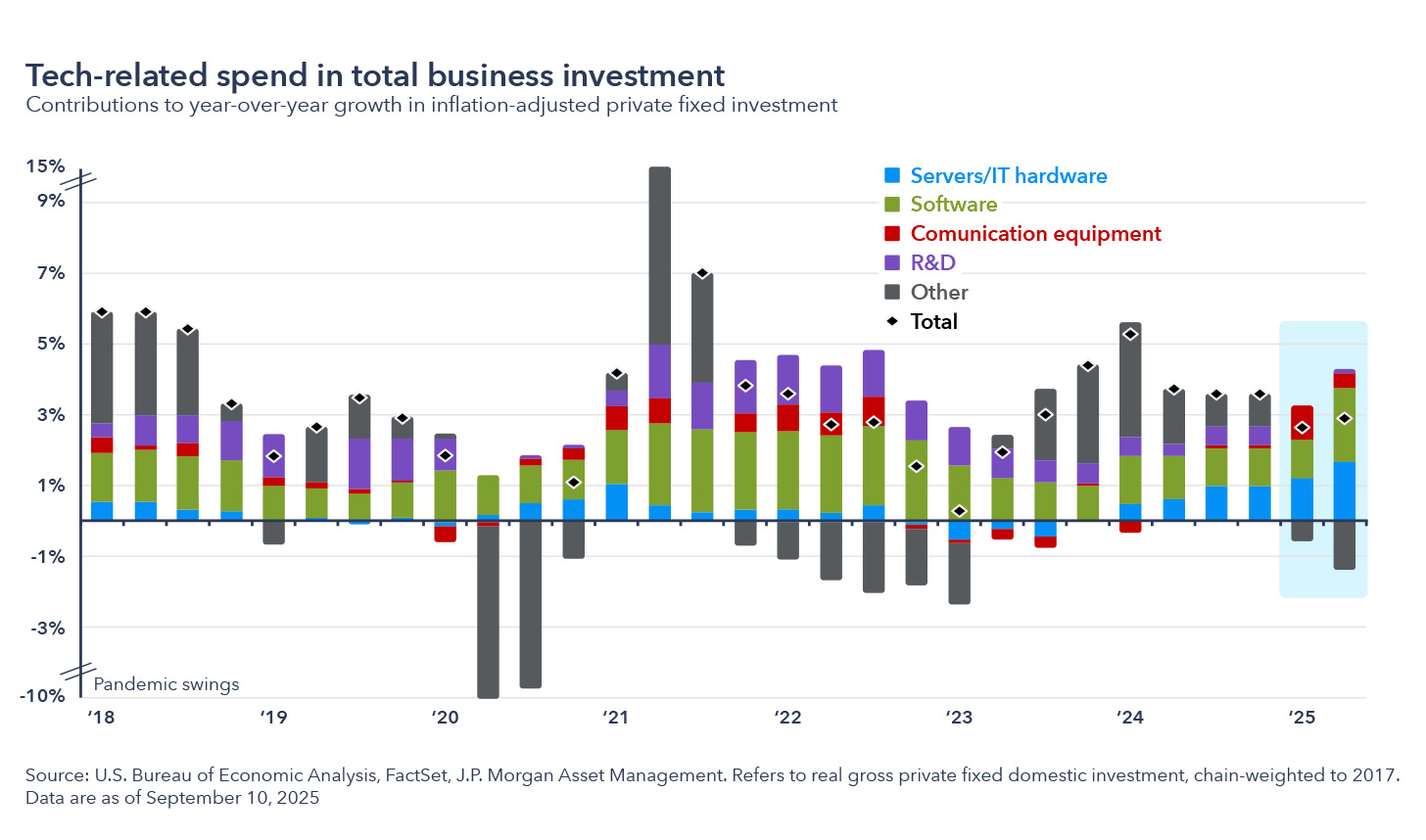
But this critique rests on a fundamental assumption: that AI investment behaves like traditional capital expenditure—factories, equipment, infrastructure that depreciates with use and eventually becomes obsolete. If that's the right framework, then yes, we should worry.
However, we do not believe this is the right framework.
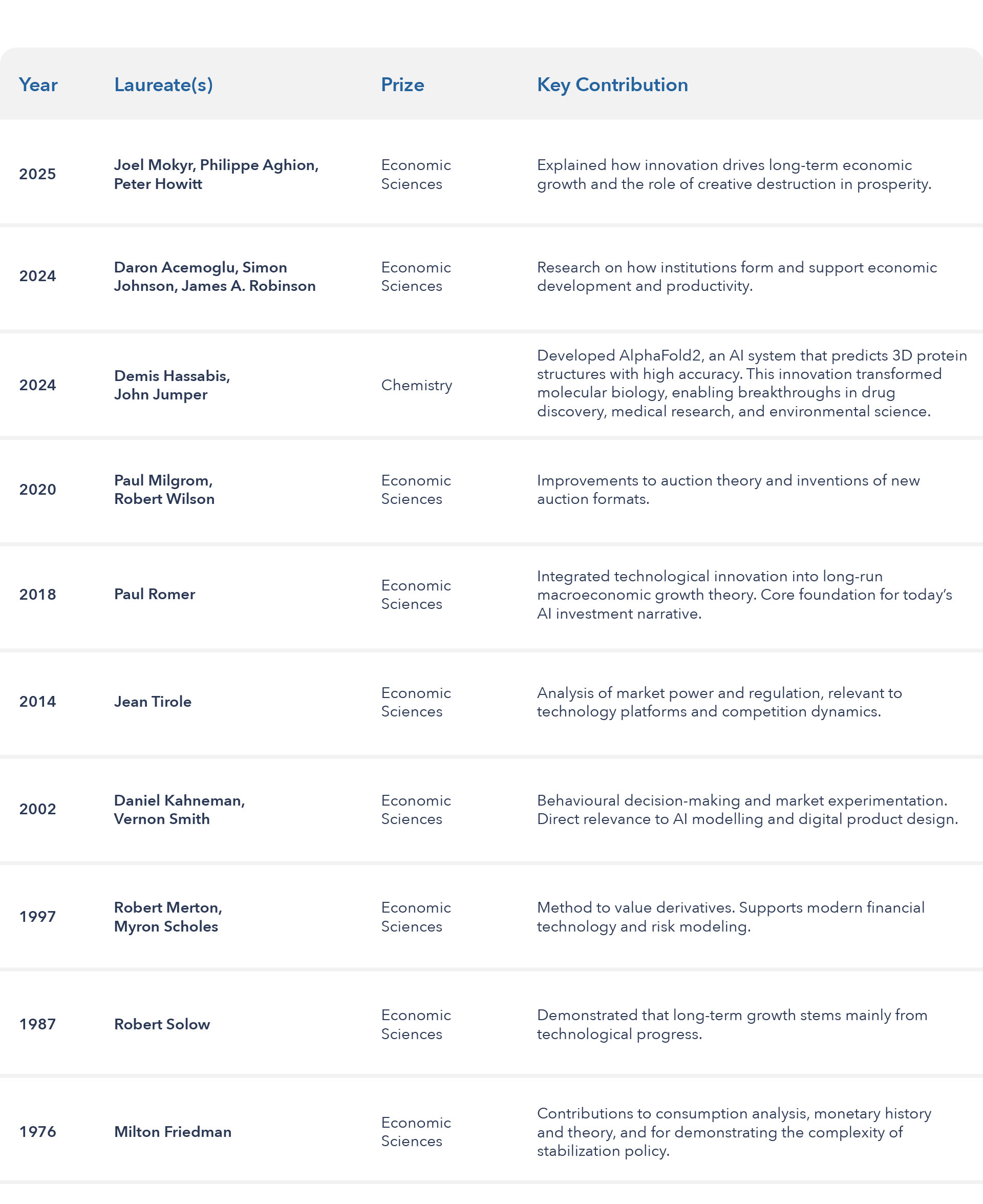
To understand what's really happening with AI investment, one needs to revisit how economists came to understand growth itself—a journey that culminated in Paul Romer's Nobel Prize-winning work in 2018. Romer's endogenous growth theory fundamentally transformed our conception of prosperity, revealing that technological progress isn't an external force acting upon economies but rather the product of deliberate choices within them. The continuing relevance of this framework was underscored just this October, when the 2025 Nobel Prize in Economics was awarded to Joel Mokyr, Philippe Aghion, and Peter Howitt "for having explained innovation-driven economic growth"—work that builds directly on the foundations Romer established.
For decades, economists relied on Robert Solow's elegant growth model, which acknowledged that technology drives long-term prosperity but treated technological progress as essentially magic—something that happened to economies rather than within them. Technology was treated as an exogenous variable that improved at an assumed rate, arriving like an unearned gift from outside the system.
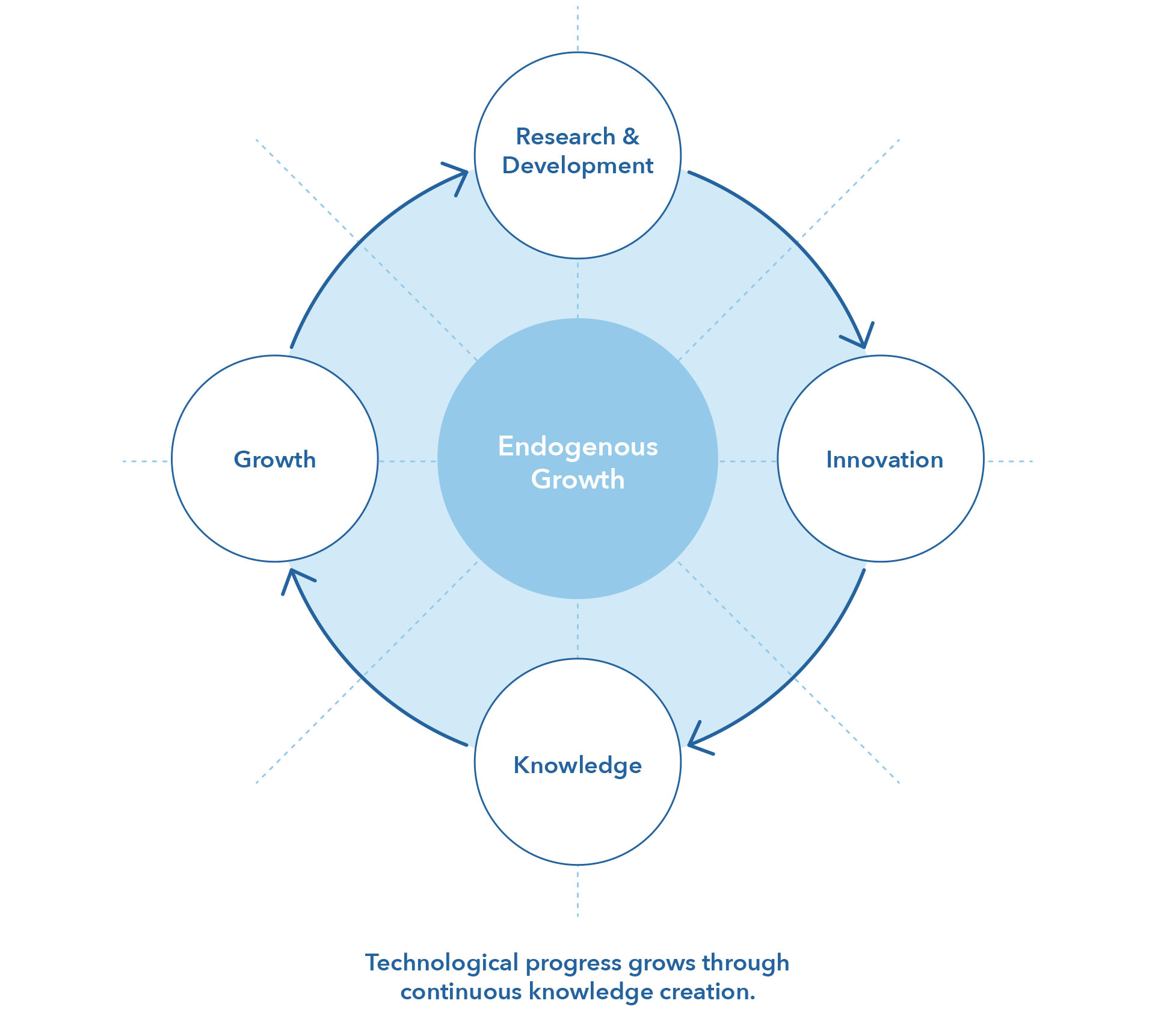
Paul Romer fundamentally restructured this understanding. His endogenous growth theory revealed that technological progress isn't a mysterious external force but the product of deliberate economic activity.
Companies invest in R&D. Researchers pursue breakthroughs. Engineers build on existing knowledge. Each innovation becomes a platform for subsequent discoveries.
The implications are profound: ideas are non-rivalrous. Unlike physical capital, which can only be deployed in one place at one time, an idea can be used simultaneously across an entire economy without diminishing its value.
When a breakthrough in machine learning occurs, it doesn't get "used up"—it becomes a foundation that thousands of companies and millions of developers can build upon.
This creates increasing returns to scale that traditional capital investment simply cannot match.
Romer's core insight—that growth comes from the intentional creation and diffusion of ideas—has proven so foundational that it continues to shape economic research today.
When we look at AI investment, we are trained to see it as capital expenditure on data centers and chips—as appears in quarterly reports. But that’s not the lens we should be looking through. What it really is, is the largest coordinated effort in human history to create non-rivalrous knowledge assets that will compound indefinitely.
Every dollar spent training foundation models, developing algorithms, or building AI infrastructure is an investment in ideas that will be reused, recombined, and refined countless times. GPT doesn't get depleted when a million developers use it. Computer vision breakthroughs don't wear out. The knowledge embedded in these systems becomes freely available raw material for the next generation of innovation.
This is precisely the mechanism Romer identified: intentional investment in idea creation, generating spillovers that benefit entire ecosystems, amplified by institutions (open-source communities, research labs, patent systems) that facilitate diffusion.
Critics see hundreds of billions in annual AI capital expenditure and worry about bubbles and overcapacity. But Romer's framework suggests we should ask different questions: Are we creating durable knowledge assets? Are these ideas diffusing across the economy? Are institutions supporting continued innovation?
The evidence suggests yes to all three. AI capabilities are being integrated into healthcare diagnostics, drug discovery, materials science, logistics, education, and software development. The ideas generated aren't trapped—they're spreading through APIs, continuously upgraded models, and competitive pressure to adopt and improve.
McKinsey data further shows AI fuelling the strongest revenue growth in marketing, finance, and product development.1
Chart shows revenue increase within business units from AI use (% of respondents)

Major technological transitions always appear concentrated during their investment phase. Railways in the 1840s. Electrification in the 1920s. The internet in the 1990s. What looks like speculation in real-time becomes, through the lens of endogenous growth theory, the necessary formation of knowledge infrastructure.
The relevant question for long-term investors isn't whether AI spending seems excessive today. It's whether this spending is creating the non-rivalrous, increasing-returns knowledge base that drives sustained growth in Romer's framework.
In that light, the unprecedented scale of AI investment isn't a warning sign. It's exactly what an economy serious about long-term growth should be doing—transforming resources into the non-rivalrous knowledge assets that, unlike any other form of capital, improve with sharing rather than diminish with use.
The 2025 Nobel laureates—Mokyr, Aghion, and Howitt—extended Solow and Romer’s work by examining how innovations displace outdated technologies through creative destruction and by identifying the historical prerequisites that enable sustained technological progress. Their recognition reinforces what long-term investors must grasp: we are not witnessing a speculative bubble in AI spending, but rather the formation of the innovation infrastructure that theory predicts will drive prosperity for decades to come.
The long-term picture isn't about whether this quarter's AI spending justified itself. It's about whether we're building the endogenous engine of innovation that Romer identified as the true source of prosperity. On that measure, the evidence is compelling: we are.

Selected Nobel Laureates in Economic Sciences Linked to Innovation and Growth1
Endogenous Growth Flywheel
AI is commoditizing software while driving new demand for physical infrastructure, marking a shift from bits to atoms that could define the decade ahead.


AI investments look excessive until you know what you're really looking at: knowledge engines that compound indefinitely, fuel decades of growth and drive tomorrow's innovation.

Explores how USD depreciation enhances GCC resilience via Asian export booms, diversification, and tourism inflows, positioning the region as a stable haven for global investors.