
The loudest wager in technology right now is to pour ever more compute into ever larger models. And having strained the power grids of three continents in the attempt, the industry has lifted its eyes to orbit.
The story of space in 2026 is no longer really the rocket.
The collapse in launch costs — one of the genuine engineering achievements of the age — has made the idea newly thinkable, and capital has responded as capital does, flowing into the whole enabling apparatus, the power and the cooling and the laser links, on the premise that orbit may become one of the most important places to run AI models. It is an intoxicating idea, and a serious one; some of the most capable people in the industry are pursuing it.
And the case is getting stronger, not weaker. Even sober analysts now model the cost gap between orbit and the ground closing steadily — from several times more expensive today toward rough parity within fifteen years, and to perhaps thirty per cent by the early 2030s, the point at which the first data centres at scale begin to pencil out1. The logic is not that orbit is somehow cheaper than Earth; it is that an AI build-out already exhausting terrestrial power will eventually need somewhere else to go, and orbit may prove to be a natural release valve — abundant power, uninterrupted sun, and room to scale without a substation or a permit.
Real engineering remains: shedding heat in a vacuum, hardening and servicing hardware against radiation. But these are problems being worked, with costs continuing to improve over time, by people with better information than ours. The destination is not in serious doubt. The open questions are the timing — and the price one pays today for a prize that arrives over a decade.
Which is why it is worth asking a second question alongside the first. While the grand version is built out over the coming decade, what can orbit do now, that pays now? Here the answer is already flying.
The data that never comes home
Start with a fact that ought to be more unsettling than it is.
A satellite in low orbit can talk to a ground station only when it is passing overhead, which it does for a few minutes on each ninety-minute lap of the planet. The rest of the time it is in radio silence, filling its storage with pictures that will be overwritten, unseen, before anyone looks at them. We have built the finest cameras in human history, placed them where they can see almost everything, and arranged matters so that most of what they see is never delivered.
The cheaper launch becomes, the worse this gets: every new satellite adds to the supply of imagery while the capacity to bring it home grows far more slowly. The binding constraint is not getting to orbit; it is getting the answer back.
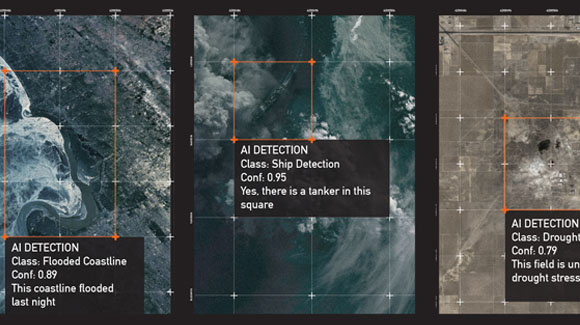
Yes, there is a tanker in this square. This coastline flooded last night. This field is under drought stress. For years this was impossible, because the chips capable of serious inference could not survive orbit. As of late 2025 they can: the first data-centre-class processor reached orbit and proved roughly a hundred times more capable than anything flown before2. The camera that could see everything can, at last, also tell you what it sees.
This is a different kind of compute from the one in the headlines — not a warehouse for the world's models, but an answer engine sitting on top of data that exists nowhere else and would otherwise be lost. China has independently reached the same conclusion and begun lofting a constellation carrying inference-grade — not training-grade — compute: built not to train models in the sky but to answer questions about the physical world, to look and to say what is there. And it is an answer that can be made nowhere else, because the data that would carry it never comes home.
Where this leaves the patient investor
The data centre in orbit is a real destination, and the capital moving toward it is not wrong about where the decade is heading. The nearer opportunity asks less of the calendar. Orbit already does one thing it alone can do — turn what it sees into an answer, at the source, before the data is lost. That is not a substitute for the grander vision. It is the same secular wave, arriving sooner, and at a price the crowd is not yet paying.
We will say more, in a separate note, about precisely which layers — the sectors within the space matter enormously, and they are the work. The thesis-level point is the simpler one, and the one that we leave you with.